visarunway.app
Visarunway
Fast-growing visa agency scaling with technology
0→2K
monthly applications in year one
60%
reduction in support inquiries
48h
from kickoff to first live application
One application is simple. A family of five, with shared and individual documents, per-person fees, and one shared deadline, is where most systems break. Here's how to handle it cleanly.
A single-applicant visa is straightforward. A family application multiplies every dimension of complexity at once: multiple applicants, a mix of shared and individual documents, fees that are partly per-person and partly flat, and timelines that must stay synchronised because the family travels together.
Most tools — and most spreadsheets — model one applicant per record. Family applications then become a tangle of duplicated rows, manually linked records, and fee calculations done by hand. It's exactly the scenario where documents get attached to the wrong person and deadlines slip.
Handling families well requires a data model and workflow designed for grouped applications from the start, not retrofitted onto a single-applicant system.
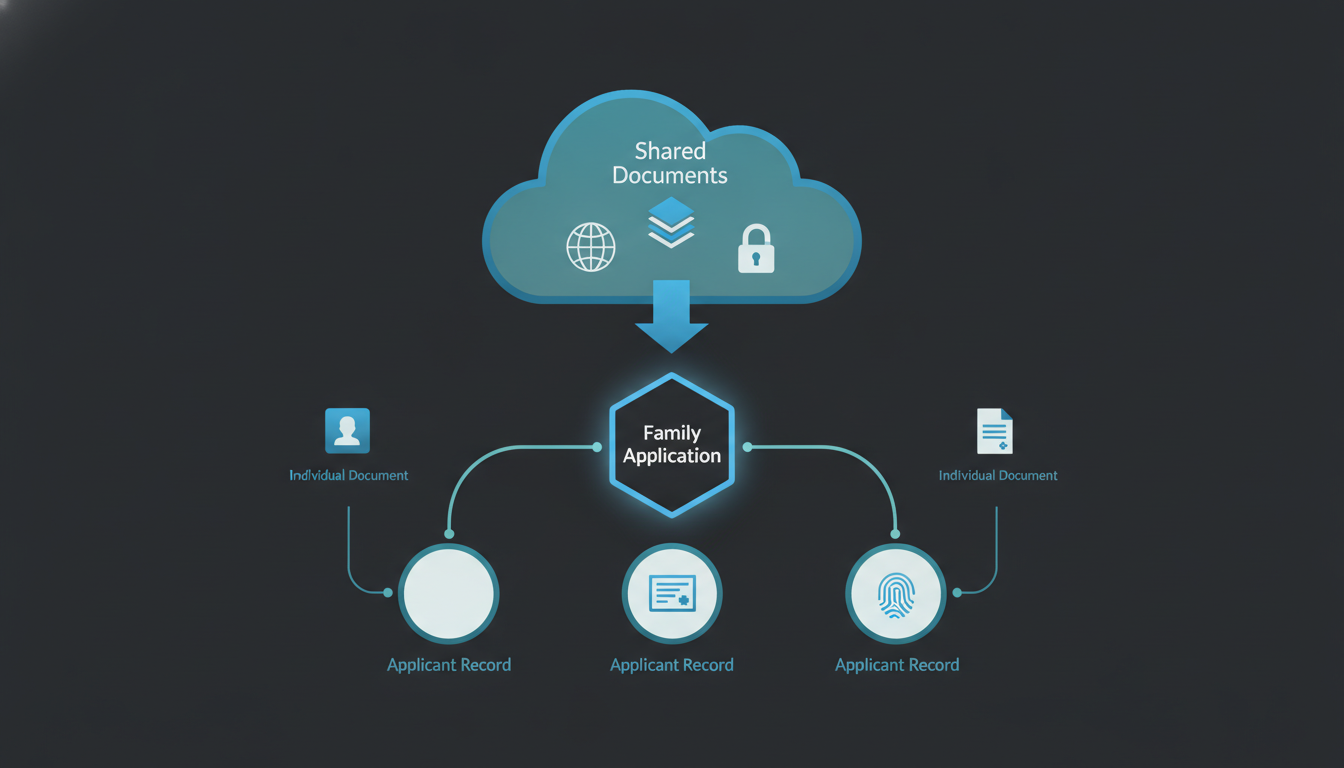
The foundation is a structure that links applicants into a single application while preserving each person's own record. The family is one case with one shared status and timeline, but each member has their own documents, passport details, and individual checks.
This lets you answer both questions that matter: "where is this family's application overall?" and "which specific documents is the youngest child still missing?" Without that dual view, you're either tracking five disconnected applications or one blob that hides the detail.
Multi-applicant support is a core requirement to look for in any visa CRM — it's one of the clearest dividing lines between tools built for visa work and generic systems adapted for it.
Book a quick demo and see how it works for your visa types.
Family applications mix two document types, and conflating them causes errors. Shared documents — like proof of accommodation, the travel itinerary, or a sponsor's financial evidence — apply to the whole group and should be uploaded once. Individual documents — passports, photos, individual bank statements — belong to each applicant.
A well-designed workflow makes this distinction explicit: upload shared documents at the application level, individual documents at the applicant level. This prevents the classic error of attaching one child's passport to another, and it stops clients from being asked to upload the same accommodation proof five times.
Clear per-applicant document tracking, layered on top of shared application documents, keeps even a large family application organised and auditable.
Family pricing is where manual processes leak money and trust. The typical structure is (government fee + service fee) × number of applicants, plus any flat-rate add-ons that apply once to the whole group. Children may have different government fees; some add-ons are per-person, others per-family.
Calculated by hand, this is slow and error-prone — and clients notice when the maths doesn't add up. A pricing engine that handles per-applicant and flat components automatically produces a transparent breakdown the client can trust: each person's fees itemised, shared add-ons shown once, and a clear total.
Transparent family pricing isn't just operationally cleaner — it directly addresses the hidden-fee anxiety that drives so much pre-sale hesitation in the visa industry. (More on this in our pricing strategy guide.)
Book a discovery call and see how VisaCRM can automate your workflow.
Book a call →Finally, family applications need communication that treats the group as a unit. The primary contact — usually one parent — should receive consolidated status updates covering the whole family, not five separate notification streams.
When a document for any family member needs correction, the notification should make clear which person and which document, sent to the primary contact with a direct link. Synchronised, group-aware notifications prevent the confusion of a parent receiving contradictory updates about different family members.
Done well, a family of five feels as smooth to the client as a single application — and to your team, it's one organised case rather than five tangled ones. Want to see grouped family applications in action? Book a demo with your visa types.
Family applications multiply complexity at once: multiple applicants, a mix of shared and individual documents, fees that are partly per-person and partly flat, and synchronized timelines because the family travels together. Most tools model one applicant per record, so families become tangled duplicate rows where documents get attached to the wrong person.
It should link applicants into a single application with one shared status and timeline, while preserving each member's own record, documents, and checks. This lets you answer both "where is this family's application?" and "which document is the youngest child still missing?" Multi-applicant support is a key dividing line between visa-specific and generic tools.
The typical structure is (government fee + service fee) × number of applicants, plus any flat-rate add-ons that apply once to the whole group. Children may have different government fees, and some add-ons are per-person while others are per-family. A pricing engine that handles these automatically produces a transparent, itemized breakdown clients can trust.
Upload shared documents — accommodation proof, itinerary, sponsor evidence — once at the application level, and individual documents like passports and photos at each applicant level. Keeping the two explicit prevents attaching one person's passport to another and stops clients being asked to upload the same shared document multiple times.
Bu yazıdaki örüntüler şu platformlarda çoktan yayında. Farklı markalar, farklı vize tipleri — altında tek bir motor.
Modern bir vize işletmesini yürütmenin derinine inen pratik rehberler.